Show Notes
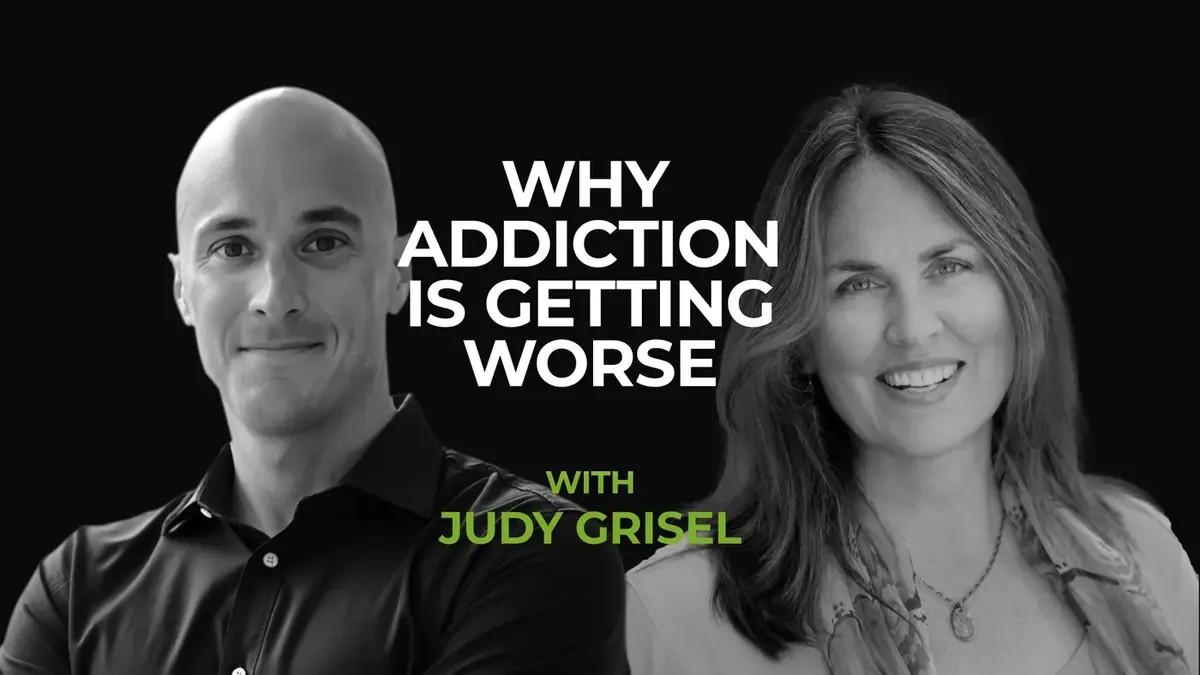
That question sits at the center of this week’s conversation with Judy Grisel - a behavioral neuroscientist, professor at Bucknell University, and someone who has spent decades studying addiction while also living through it herself.
At 12 years old, Judy describes alcohol as: “the solution to a problem I didn’t know I had.”
What followed was a decade-long spiral through substance abuse, homelessness, expulsion from multiple schools, and profound despair… before eventually finding sobriety and becoming a neuroscientist focused on understanding addiction, reward, and the brain.
What makes Judy especially compelling isn’t just her scientific expertise.
It’s the combination of deep neuroscience with lived experience.
In this conversation, we explore why addictive behaviors often begin as solutions… how the brain adapts in ways that trap us in destructive cycles… and why addiction may actually be getting worse despite decades of scientific progress.
One of the biggest themes we discuss is this:
Our biology hasn’t changed.
But our environment has.
We now live in a world of:
- Higher potency substances
- Constant access
- Earlier exposure
- And behavioral addictions designed to capture attention and reinforce compulsive behavior
And the brain adapts accordingly.
We also dive into:
- Dopamine and reinforcement
- Why adolescents are especially vulnerable
- Evolutionary mismatch and the modern environment
- The limits of willpower
- And why there may be “no shortcut” when it comes to feeling better
What I appreciated most about Judy’s perspective is that it avoids simplistic answers.
This conversation isn’t just about addiction. It’s about how the brain learns, adapts, copes, and searches for relief in the modern world.
If your brain fuels your life… what fuels your brain?
Your friendly next door neuroscientist,
Jamey
- Subscribe on YouTube: https://www.youtube.com/@NextDoorNeuro
- Subscribe to your top podcast: https://nextdoorneuro.transistor.fm/